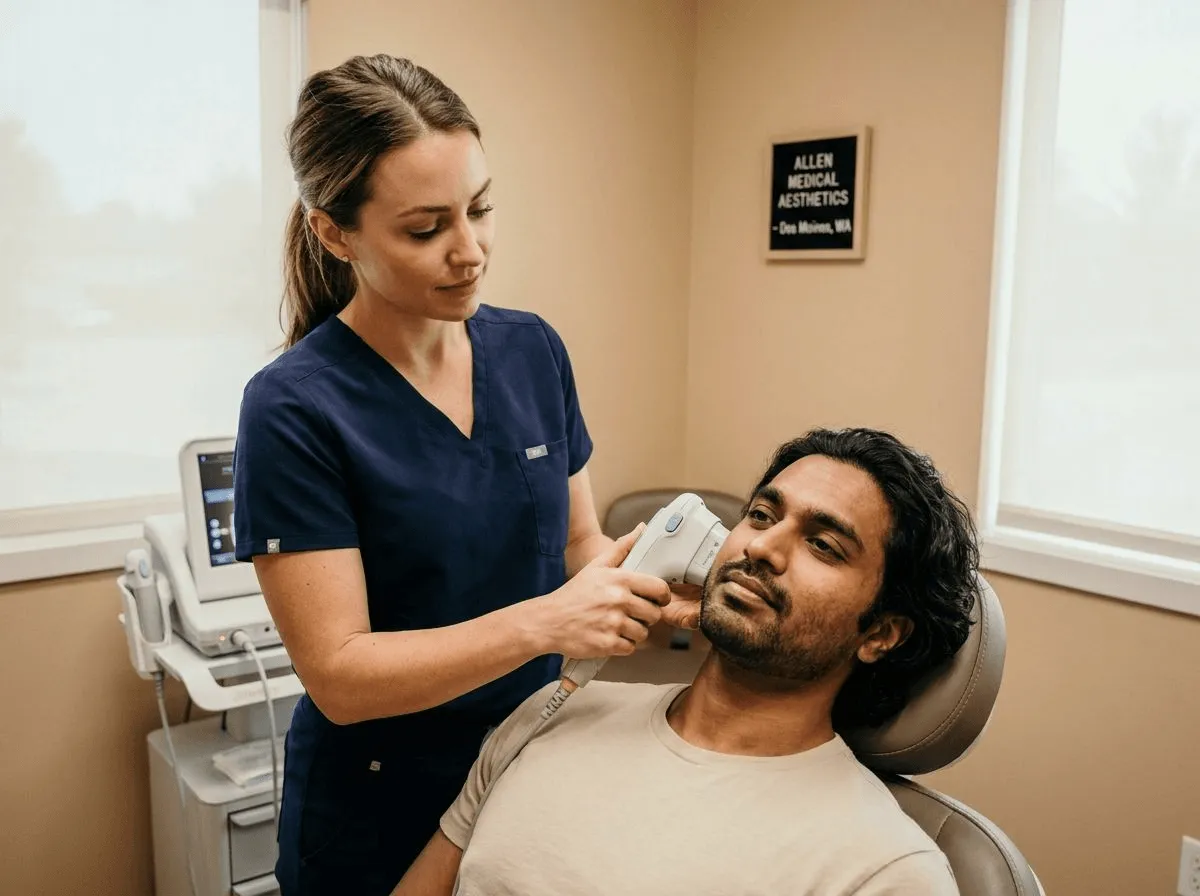
If you have researched non-invasive skin tightening, you have likely encountered Ultherapy alongside bold marketing claims about "lifting without surgery." You may have also encountered reviews from patients who were underwhelmed or confused about what to expect. This disconnect between marketing and patient experience raises a fair question: does Ultherapy actually work?
The honest answer is nuanced. Ultherapy holds FDA clearance for lifting the brow, chin, and jawline, and for improving lines and wrinkles on the decolletage, and it produces real results for the right candidates. But it is not a miracle treatment, it has limitations, and it does not work equally well for everyone. Understanding the mechanism and the realistic expectations is essential for making an informed decision.
At Allen Medical Aesthetics, we believe patients deserve transparent information. This guide explains how micro-focused ultrasound with visualization (MFU-V) works at the tissue level, and provides an honest assessment of what Ultherapy can and cannot do.
Yes, Ultherapy works for the right candidate. It holds FDA clearance for lifting the brow, chin, and jawline, and for improving lines on the decolletage, and it produces real tissue tightening through collagen remodeling. Results are gradual and more modest than a surgical facelift. The treatment works best for patients with mild to moderate laxity who have realistic expectations about non-surgical outcomes.
Ultherapy uses FDA-cleared micro-focused ultrasound to produce tissue lifting and tightening through collagen remodeling. It is not equivalent to a facelift, and not every patient will be satisfied with the degree of improvement. Candidacy assessment is critical.
The Science: How HIFU Creates Tissue Change
Ultherapy uses a technology called micro-focused ultrasound with visualization, or MFU-V. This is a form of high-intensity focused ultrasound (HIFU) that has been adapted for aesthetic applications. Understanding the mechanism helps explain both why the treatment works and why it has inherent limitations.
The device generates ultrasound waves that are focused to converge at specific depths beneath the skin, similar to how a magnifying glass focuses sunlight to a single point. At the focal point, the concentrated energy creates tiny, precisely placed thermal coagulation points (TCPs) in the tissue.
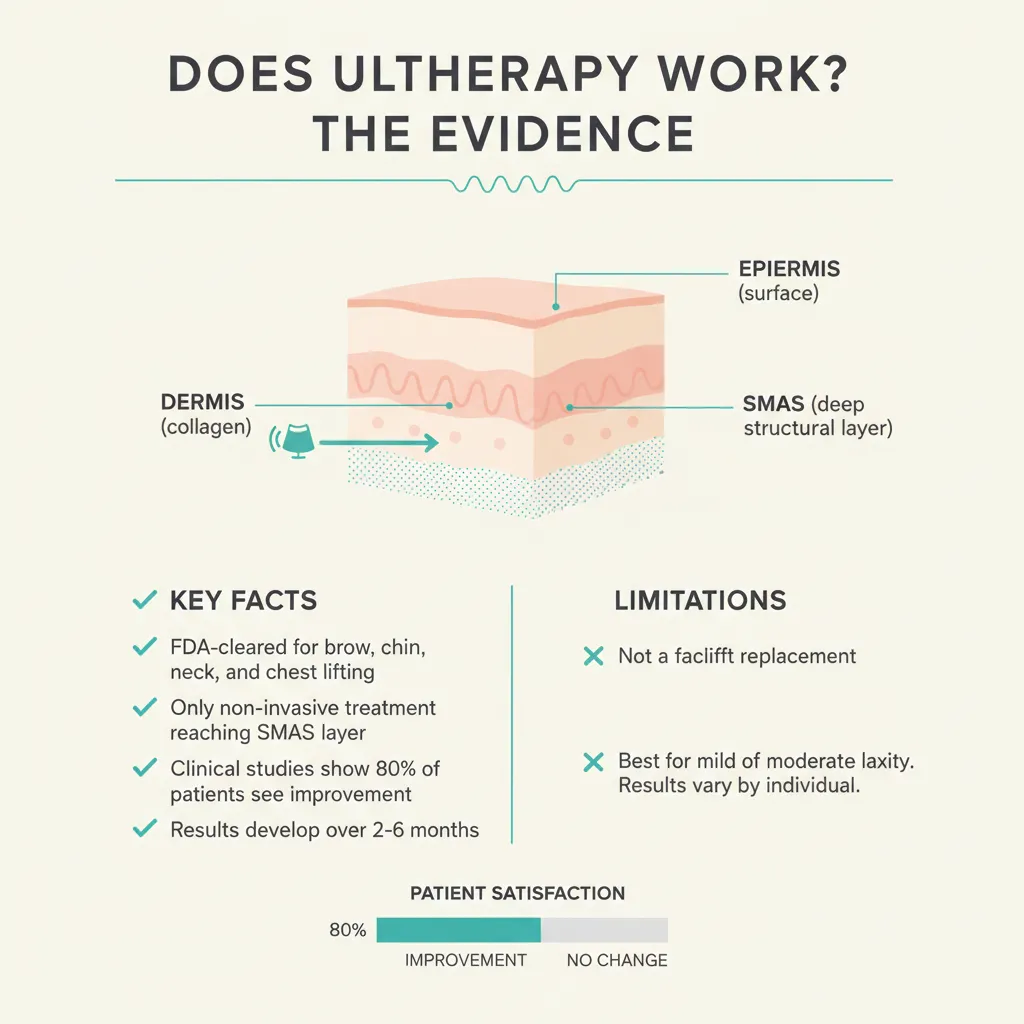
These thermal coagulation points trigger a controlled wound healing response. The body recognizes the thermal injury and initiates a repair process that includes inflammation, new collagen synthesis, and tissue remodeling. Over 2 to 6 months, new type I and type III collagen fibers form around each TCP, gradually tightening and lifting the treated tissue.
What makes Ultherapy unique among non-invasive devices is its ability to target the superficial muscular aponeurotic system (SMAS), the same fibrous tissue layer that plastic surgeons manipulate during facelift procedures. By delivering energy to this depth without cutting the skin, Ultherapy can produce structural tissue changes that more superficial treatments cannot achieve.
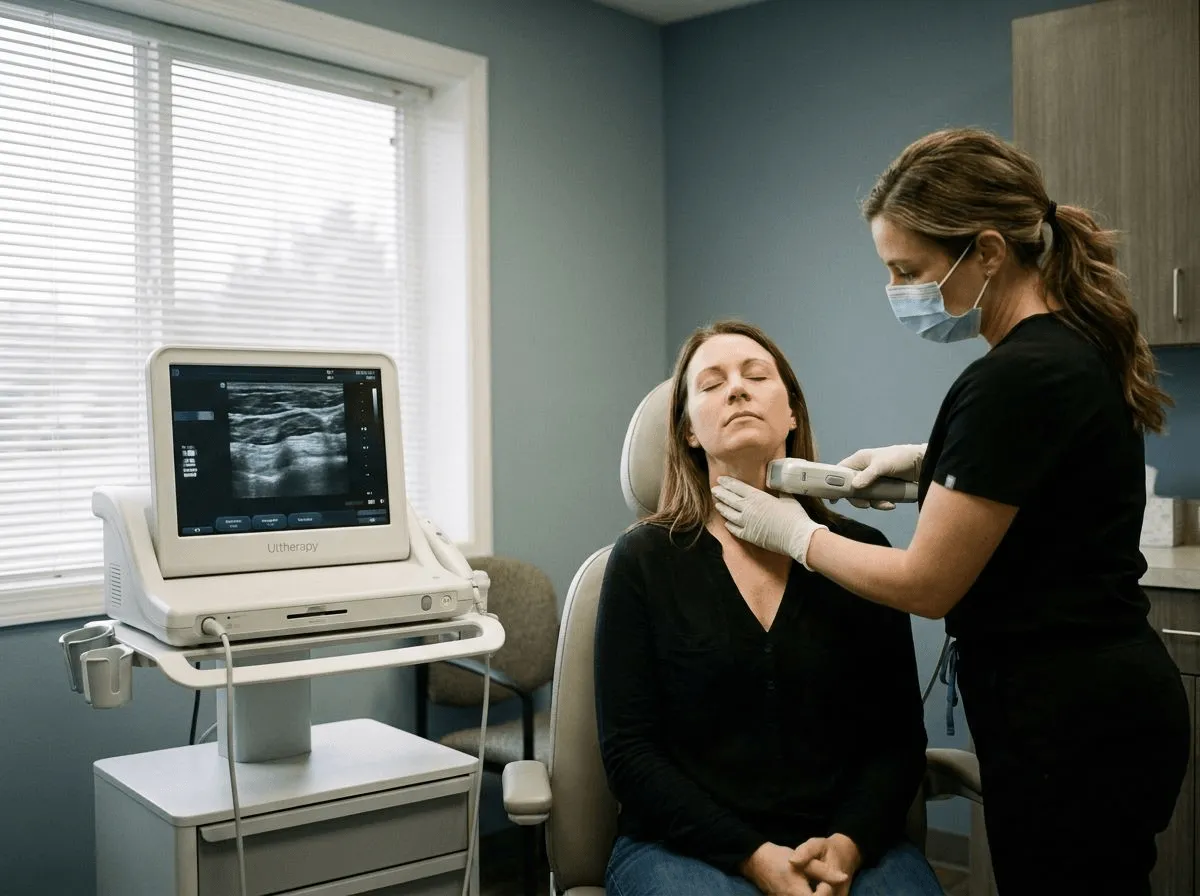
The "visualization" component of MFU-V refers to the real-time ultrasound imaging that allows providers to see the tissue layers being treated. This imaging capability lets experienced practitioners identify the optimal treatment depth for each area and confirm that energy is being delivered to the correct tissue plane.

“What makes Ultherapy unique is that it reaches the SMAS layer, the same deep structural tissue that surgeons address in a facelift, but without a single incision. The focused ultrasound energy creates precise thermal points that trigger your body to rebuild collagen from the inside out. When patients understand that mechanism, they also understand why the results are real and why they take time to fully develop.”
Linda Borge Jouini, MSN, RN Aesthetic Nurse Injector
FDA Clearance and How Ultherapy Works
Ultherapy holds FDA clearance (not approval, an important distinction) for non-invasive lifting of the brow, chin, and jawline, and for improving lines and wrinkles on the decolletage. FDA clearance means the device has been demonstrated to be safe and effective for its indicated uses, but the regulatory pathway (510(k)) is different from full FDA approval.
The degree of visible lifting depends heavily on individual factors: the amount of laxity present before treatment, skin thickness, and how robustly each patient's own tissue responds to the ultrasound stimulus. This is why results are not identical from one patient to the next, and why a thorough candidacy assessment matters more than the technology alone.
Ultherapy is also used to address lines and crepiness on the chest, since the same collagen-stimulating mechanism that lifts the brow, chin, and jawline applies to the decolletage. As with the face and neck, the degree of visible smoothing varies by individual skin quality and the extent of sun damage present before treatment.
It is worth noting that Ultherapy, like most energy-based aesthetic devices, does not produce identical results across every patient. We recommend approaching any device with realistic, mechanism-based expectations rather than marketing claims, which is why candidacy and expectation-setting are the focus of the sections below.
Realistic Expectations vs Marketing
This is where honest assessment becomes critical. Ultherapy marketing, both from the manufacturer and from some clinics, sometimes creates expectations that exceed what the treatment can reliably deliver.
What the marketing often implies: Dramatic, visible lifting comparable to a non-surgical facelift. Transformation that is immediately visible. Universal effectiveness across all patients and degrees of aging.
What Ultherapy realistically delivers: Subtle to moderate lifting and tightening that develops gradually over 2 to 6 months, with the best results in patients who have mild to moderate laxity. The degree of change is meaningfully less dramatic than what a surgical facelift can achieve.
The gap between these two realities is the primary source of patient dissatisfaction. When patients expect dramatic, surgery-like results from a non-invasive procedure, they are almost certainly going to be disappointed. When patients understand that they are investing in a meaningful but incremental improvement, satisfaction rates are significantly higher.
At Allen Medical Aesthetics, we consider the consultation process as important as the treatment itself. If we evaluate a patient and determine that their degree of laxity exceeds what Ultherapy can realistically address, we will say so. Recommending a treatment that is unlikely to meet a patient's goals is not something we consider good medicine.
If a provider promises "dramatic lifting" or "facelift-like results" from Ultherapy without qualifying those claims, consider it a red flag. Honest providers set expectations based on clinical evidence, not marketing materials.
Questions about skin rejuvenation?
Our providers offer consultations to discuss your options. The $50 fee is applied toward your first treatment.
Talk to a ProviderWho Ultherapy Works Best For
Patient selection is arguably the most important factor in Ultherapy outcomes. The treatment is not universally effective, and identifying the right candidates is essential for delivering results that meet expectations.
Ideal Candidates
The strongest Ultherapy candidates are patients aged 30 to 65 with mild to moderate skin laxity. They have noticed that their skin has started to lose its firmness (a softening jawline, mild brow descent, early neck laxity, or chest crepiness) but the changes are not severe enough to warrant surgery. They understand that the treatment produces gradual improvement, not instant transformation.
Patients with good underlying skin quality, meaning they have protected their skin from excessive sun damage, do not smoke, and have reasonable collagen production capacity, tend to respond better. Thicker skin types also tend to produce more visible results because there is more tissue substrate for the collagen remodeling to work with.
Patients Who May Be Disappointed
Patients with significant skin laxity (heavy jowling, pronounced neck banding, or substantial submental fullness) are unlikely to achieve their goals with Ultherapy alone. These conditions typically require surgical intervention, such as a facelift, neck lift, or submentoplasty, for meaningful correction.
Very thin patients with minimal subcutaneous fat and thin skin may find that the ultrasound energy produces discomfort disproportionate to the results achieved, because there is less tissue to treat and the energy is delivered closer to nerve structures.
Patients with very mild laxity (those in their late 20s or early 30s with minimal visible aging) may not see enough change to justify the investment, simply because there is not enough laxity present for the treatment to address.
Limitations of Ultherapy
Every treatment has limitations, and being transparent about them is essential for informed decision-making.
It cannot replace surgery. Ultherapy produces lifting within a non-surgical range. For patients who need significant tissue repositioning or skin removal, a surgical facelift remains the gold standard. Ultherapy can delay the need for surgery or complement surgical results, but it is not an alternative to a facelift for patients with advanced aging.
Results vary significantly between patients. Even among patients with similar degrees of laxity, the collagen response varies. Factors like age, genetics, overall health, and lifestyle all influence how robustly your body responds to the ultrasound stimulus. A meaningful share of treated patients report being unsatisfied or perceiving minimal improvement, which is why candidacy assessment matters more than enthusiasm for the technology.
The treatment can be uncomfortable. Ultherapy involves delivering focused energy to deep tissue, and many patients report significant discomfort during the procedure, particularly along the jawline and forehead. Pain management strategies (including topical anesthetics, oral medications, and nerve blocks) can help, but the treatment is not painless.
Results are not immediate. The 2 to 6 month timeline for collagen remodeling means you will not see your results for months. This gradual progression requires patience and makes it difficult to assess the treatment's effectiveness in the short term.
Cost consideration. Ultherapy is a significant financial investment, typically ranging from $2,000 to $5,000 depending on the treatment area. Given the variable response rates, patients should weigh the cost against the realistic probability and degree of improvement.
Ultherapy vs Surgical Alternatives
For patients considering their options, understanding how Ultherapy compares to surgical alternatives helps frame the decision.
A surgical facelift repositions the SMAS and underlying tissue, removes excess skin, and produces dramatic, long-lasting results (typically 7 to 10 years or more). Recovery involves weeks of downtime, surgical risks including nerve injury and scarring, and costs ranging from $10,000 to $20,000 or more. The results are the most dramatic available, but the procedure is invasive.
Ultherapy works on the same tissue layer but from outside the body, without cutting, repositioning, or removing tissue. The results are more modest than surgery, but the procedure has zero downtime, no surgical risks, and can be completed in 60 to 90 minutes. The cost is substantially lower.
The choice depends on the degree of correction needed, risk tolerance, budget, and willingness to undergo surgery. Many patients choose Ultherapy as a bridge treatment, addressing early laxity non-invasively and delaying surgical intervention by several years.
| Factor | Ultherapy | Surgical Facelift |
|---|---|---|
| Invasiveness | Non-invasive (no incisions) | Invasive (incisions, general anesthesia) |
| Downtime | None | 2 to 4 weeks |
| Degree of improvement | Modest, non-surgical range | Dramatic, full surgical range |
| Results timeline | 2 to 6 months (gradual) | Immediate (with swelling resolution over weeks) |
| Longevity | 1 to 2 years | 7 to 10+ years |
| Risk profile | Minimal (redness, swelling, rare nerve sensitivity) | Moderate (infection, nerve injury, scarring, anesthesia risks) |
| Cost range | $2,000 to $5,000 | $10,000 to $20,000+ |
How Allen Medical Approaches Ultherapy
Our approach to Ultherapy at Allen Medical Aesthetics is built on candidacy assessment, transparent expectation-setting, and technical expertise.
During the consultation, we evaluate your skin laxity, tissue thickness, treatment goals, and overall health to determine if Ultherapy is likely to deliver results that meet your expectations. If we believe another treatment or combination of treatments would serve you better, we will recommend that alternative.
For patients who are strong candidates, we develop a customized treatment plan that includes the specific areas to be treated, the transducer depths to be used, and the number of treatment lines appropriate for your anatomy. We also discuss pain management strategies to ensure the treatment is as comfortable as possible.
We combine Ultherapy with complementary treatments when appropriate. RF microneedling with SylfirmX addresses surface and mid-dermal texture that Ultherapy's deeper focus does not fully treat. Biostimulatory fillers can restore volume that Ultherapy cannot replace. Together, these treatments create a comprehensive approach to skin laxity that addresses aging at multiple tissue levels.
Frequently Asked Questions
Is Ultherapy FDA approved?
Ultherapy is FDA cleared (via the 510(k) pathway) for non-invasive lifting of the brow, chin, and jawline, and for improving lines and wrinkles on the decolletage. FDA clearance is based on demonstrated safety and effectiveness, though it is a different regulatory pathway than full FDA approval.
What percentage of patients see results from Ultherapy?
Most patients with mild to moderate skin laxity see visible improvement, though the degree varies based on individual factors such as age, skin quality, and how much laxity was present before treatment. Patients with more advanced laxity or expectations closer to a surgical facelift are less likely to be satisfied with a non-surgical result.
Why do some people say Ultherapy did not work for them?
The most common reasons for dissatisfaction are unrealistic expectations (expecting facelift-level results), poor candidacy (too much laxity for non-invasive treatment), insufficient collagen response (which varies by individual), or evaluating results too early (before the 3 to 6 month collagen remodeling window).
Is Ultherapy worth the money?
For the right candidate, Ultherapy provides meaningful, measurable improvement without surgery, downtime, or significant risk. The value depends on your degree of laxity, your expectations, and how much you value avoiding a surgical procedure. A thorough consultation helps determine if the investment aligns with the likely outcome.
How painful is Ultherapy?
Most patients describe the sensation as uncomfortable rather than painful, with brief pulses of heat and pressure during energy delivery. The jawline and forehead tend to be the most sensitive areas. Pain management options include topical numbing cream, oral analgesics, and, in some cases, nerve blocks or nitrous oxide.
Can Ultherapy make skin worse?
When performed correctly on appropriate candidates, Ultherapy does not make skin worse. Temporary side effects (redness, swelling, tingling, tenderness) resolve within days to weeks. Rare complications like temporary nerve sensitivity or bruising are uncommon and self-resolving.
Related Articles
This article supports our Ultherapy service page. Learn more about treatment options, candidacy, and what to expect.