

Men have always dealt with body hair, but managing it used to mean an endless rotation of razors, trimmers, and waxing appointments that never fully solved the problem. A growing number of men are instead choosing laser hair removal to address hair on the back, chest, shoulders, neckline, and ears with a treatment plan built around how male hair actually grows and how much of it there typically is.
If you are picturing a service exclusively for women, it is worth resetting that assumption. At Allen Medical Aesthetics in Des Moines, WA, men make up a real part of our laser hair removal practice, and the process is the same no matter who is in the chair: an assessment of your hair type and skin tone, followed by a treatment plan built around your body, not adapted from someone else's. This guide covers the areas men request most, how coarse hair affects your results, how many sessions to plan for, and what a treatment day actually looks like.
Men most commonly treat the back, chest, shoulders, neckline, beard line, and ears. Male body hair tends to be coarser and denser than the hair on many other treatment areas, which generally means it responds well to laser energy, though dense areas like the back may need a session or two more than finer areas to reach the same level of clearance. Laser hair removal produces permanent hair reduction, not permanent removal, and most men complete an initial series of 6 to 10 sessions depending on the area treated.
Coarse, dense hair on the back, chest, and shoulders is exactly the hair type laser hair removal is built to target. Expect a session count on the higher end of the typical range and a plan built specifically around male hair density, not a smaller version of a plan built for someone else.
Common Treatment Areas for Men
Men request laser hair removal for a specific set of areas, and each one has its own considerations for hair density, skin thickness, and how the treatment is planned.
Back and Shoulders
The back is one of the most requested areas for men, largely because it is the hardest to manage on your own. Shaving requires help or awkward reaching, and waxing a large area is time consuming and uncomfortable every single time. Back hair tends to be coarse and dense, which is exactly the profile laser hair removal handles well. Shoulders are usually treated in the same session as the back, since the two areas share similar hair density and generally follow the same treatment schedule.
Because the back and shoulders cover more surface area than most other treatment zones, sessions here run longer than sessions on smaller areas like the neckline or ears. That is a function of size, not difficulty. The treatment itself is the same process, just repeated across a bigger surface.
Chest
Chest hair varies more from patient to patient than back hair does, both in density and in how far it extends toward the shoulders or up the neck. We map the treatment area during your consultation so the outcome looks natural rather than leaving an obvious hard edge. The skin around the nipples is more sensitive than the rest of the chest, and your provider will account for that during treatment.
Some men treat the chest on its own. Others combine it with the back and shoulders in the same visit since all three areas are usually on a similar session schedule. Either approach works, and your provider can group areas however makes sense for your goals and your calendar.
Neckline and Beard Shaping
Not every man treating facial hair wants it gone entirely. A common request is neckline and cheek line shaping: using the laser to clean up and hold a sharp, defined beard line so you are not re-shaving or trimming that boundary every day. This is a precision job, not a bulk-clearance job, and it is one reason treatments are performed by ARNPs and licensed master aestheticians who can assess your natural growth pattern and work with it rather than against it.
Ears
Hair on and around the outer ear is a common request that men rarely bring up until they are already in the room for something else. It is a small treatment area, sessions are quick, and standard eye and ear protection protocols apply just as they do for any facial area.
What Coarse Hair Means for Your Results
Laser hair removal works by targeting melanin, the pigment in the hair shaft. The laser's energy is absorbed by that pigment and converts to heat, which travels down to the follicle and disables it. Coarse, dark hair, the kind most men have on the back, chest, and shoulders, contains more melanin per hair than fine hair does, which means it absorbs more energy and gives the laser a stronger target to work with.
That same density is also why dense areas can feel more noticeable during treatment and why a large area like the back takes longer to complete than a small one like the ears. Built-in cooling technology on our lasers and topical numbing options help manage that during the session, and the sensation eases as hair thins with each subsequent treatment.
It is worth being precise about the outcome you are working toward. Laser hair removal produces permanent hair reduction: a long-term, substantial decrease in hair regrowth, not a guarantee that every follicle is gone for good. Dormant follicles can activate later, so periodic maintenance sessions are part of the plan for most men, particularly on hormonally influenced areas like the chest and beard line.
How Many Sessions Men Typically Need
One distinction worth making up front: laser hair removal is grooming maintenance, not a single procedure with a single endpoint. A full session series produces permanent hair reduction, a real and lasting decrease in regrowth, but it is not the same as permanent removal. Even after a completed series, most men keep a light annual or twice-a-year maintenance session on the schedule to manage any hair from follicles that were dormant during the original treatment.
Session counts depend on the treatment area, hair density, and your individual growth cycle. The table below reflects what we see most often for the areas men treat.
| Treatment Area | Typical Sessions | Session Interval | Expected Reduction |
|---|---|---|---|
| Back | 6 to 10 | 6 to 8 weeks | Substantial with a full series |
| Shoulders | 6 to 10 | 6 to 8 weeks | Generally tracks with the back |
| Chest | 6 to 8 | 6 to 8 weeks | Substantial with a full series |
| Neckline and Beard Shaping | 6 to 8 | 4 to 6 weeks | Consult-dependent, defined by goal |
| Ears | 6 to 8 | 4 to 6 weeks | Consult-dependent |
Neckline, beard, and ear treatments are goal-dependent rather than clearance-dependent. Some men want full reduction, others want a defined, low-maintenance line. Your provider builds the plan around which of those you are after, not the other way around.
Questions about laser and skin?
Our providers offer consultations to discuss your options. The $50 fee is applied toward your first treatment.
Talk to a ProviderWhat Your Treatment and Cost Actually Look Like
Most men combine areas, treating the back, chest, and shoulders together in a single visit rather than scheduling them separately. Combining areas is common enough that pricing is typically structured around packages rather than a single flat per-area rate. If you want the full breakdown of how pricing works and what a realistic budget looks like, our laser hair removal cost guide walks through it in detail.
Financing options, including Cherry, CareCredit, and Sunbit, are available if you would rather spread the cost of a full treatment series across a few months instead of paying for it all at once.
“Men are often surprised by how straightforward this is once they come in. We treat a lot of back, chest, and shoulder hair, and it is dense, coarse hair that laser handles well. The neckline and beard shaping requests are some of my favorite work because it is precise, and the payoff, not having to touch up that line every morning, is immediate.”
Guidance from the clinical team at Allen Medical Aesthetics
Your First Visit and Aftercare
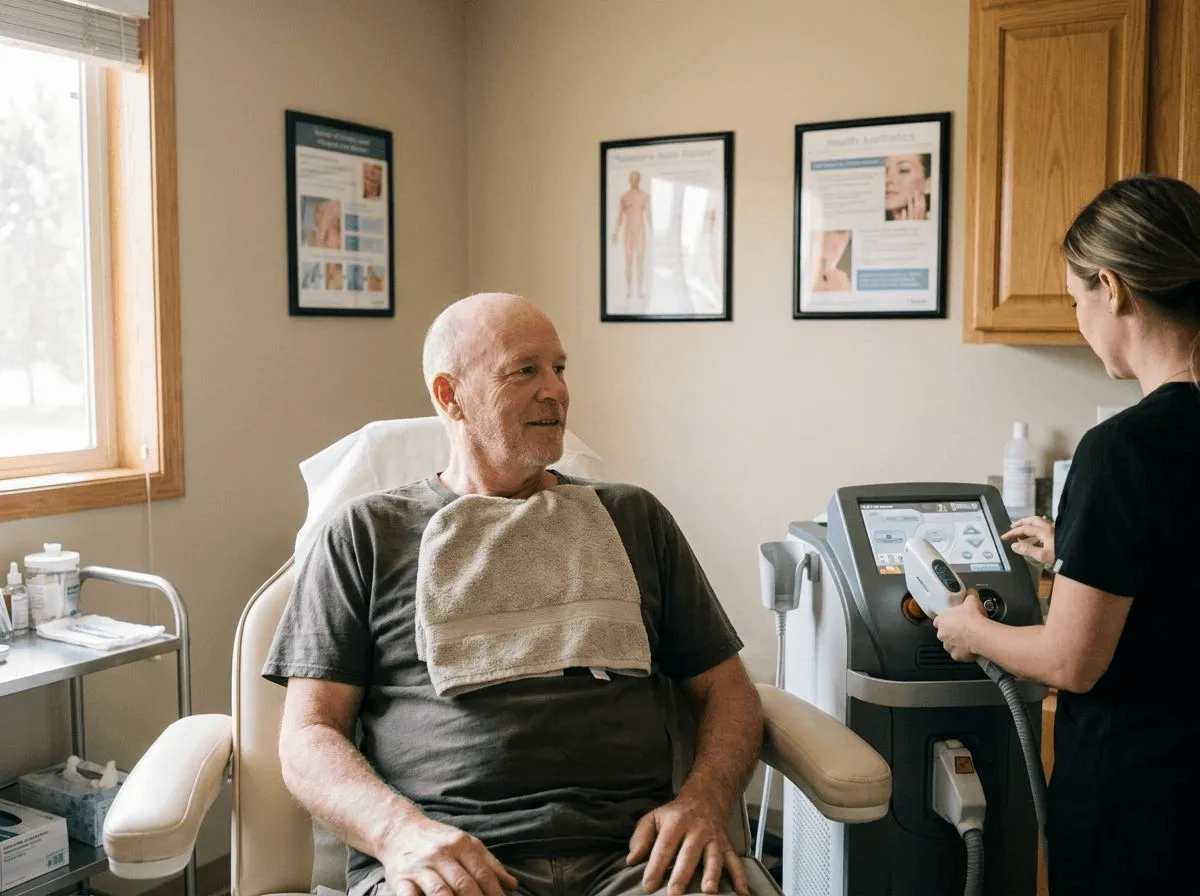
Your first visit starts with a consultation: a review of your hair type, skin tone, treatment goals, and health history. Our board-certified medical director, Tod Work, ARNP, oversees all treatments, and every session is performed by an ARNP or a licensed master aesthetician trained on the areas you are treating.
We ask you to shave the treatment area 12 to 24 hours before your appointment so the laser energy reaches the follicle rather than burning surface hair. During treatment, cooling technology keeps the skin comfortable, and topical numbing is available if you want it, especially for the neckline or ears.
Afterward, expect mild redness or warmth for a few hours, similar to a light sunburn. There is no real downtime: most men go straight back to work or the gym the same day. Avoid direct sun exposure on the treated area until it settles, and keep up with your scheduled sessions since consistent spacing is what actually produces the reduction you are paying for.
Consistency matters more than any single session. Each appointment catches hair follicles that happen to be in an active growth phase at that moment, and skipping or spacing sessions further apart than recommended leaves more follicles untouched, which means more visible regrowth between visits.
If you are ready to get started, call us at (206) 414-9979 or schedule a consultation online. We will look at your hair and skin in person and build a plan around the areas you actually want treated.
Frequently Asked Questions
Is laser hair removal different for men than for women?
The technology and process are the same. What differs is the treatment plan. Men most often treat the back, chest, shoulders, neckline, and ears, and male body hair tends to be coarser and denser than the hair treated on many female patients, which affects session count and how areas are grouped together.
Does coarse back and chest hair make treatment more effective?
Generally, yes. Laser hair removal targets melanin in the hair shaft, and coarse, dark hair contains more melanin than fine hair, giving the laser a stronger target. Dense areas like the back may need a session or two more than finer areas simply because of the volume of hair, not because the hair responds poorly.
How many sessions do men typically need for the back and chest?
Most men need 6 to 10 sessions for the back and 6 to 8 sessions for the chest, spaced 6 to 8 weeks apart. The exact number depends on hair density, skin tone, and how your individual hair growth cycle responds to treatment.
Can I get my neckline and beard line shaped instead of fully removed?
Yes. Neckline and beard shaping is one of the more common facial requests from men. The goal is a clean, defined line that holds between grooming sessions rather than complete removal of all facial hair. Your provider builds the plan around that goal during your consultation.
Is laser hair removal safe for the ears?
Yes, when performed by a trained provider using standard eye and ear protection protocols. It is a small treatment area and sessions are quick.
Do you offer financing for a full treatment series?
Yes. We offer Cherry, CareCredit, and Sunbit financing so you can spread the cost of a treatment series over time rather than paying for the full series upfront.
Related Articles
This article supports our Laser Hair Removal service page. Learn more about treatment options, candidacy, and what to expect.