

Search for "PRF hair before and after" and you will mostly find dramatic side-by-side photos promising thick, restored hair in weeks. That does not match how PRF actually works, and patients who expect that kind of transformation are often disappointed by month two, right when the treatment is just getting started biologically.
We are not going to show you a gallery of outcome photos here. Even if we had one, a single before-and-after pair from one patient tells you little about what your own results will look like. Instead, this is an honest description of the timeline, why the early months can look like nothing is happening, and a practical way to track your own progress.
This is a companion piece to our article on whether PRF actually works for hair loss, which covers mechanism and candidacy in more depth. Here, we focus on what "before and after" means for this treatment, and how to evaluate progress instead of relying on someone else's photos.
PRF hair restoration produces gradual change, not a single before-and-after moment. Reduced shedding tends to show up first, often within one to three months. Density and shaft thickness improvements, if they come, generally become noticeable between three and six months, with the fuller picture emerging over six to twelve months as the initial series and the hair growth cycle both complete. The most reliable way to judge your own progress is standardized photography taken at fixed intervals under the same lighting and angle, not a memory of how your scalp looked a few weeks ago.
There is no single before and after photo for PRF. There is a timeline, and the only fair way to evaluate it is to document your own scalp consistently over months, not to compare yourself to someone else's result.
What "Before and After" Honestly Means for PRF
For a treatment like a filler or a laser session, before and after photos can capture an immediate, visible change. PRF hair restoration does not work that way, and treating it as if it does sets up an unfair comparison.
PRF is a series of scalp injections designed to support hair follicles that are still active, not a single procedure with an instant reveal. The change it produces, when it happens, is gradual: less shedding, then a subtle improvement in shaft thickness, then, over a longer stretch, a fuller sense of density in the treated area. It shows up as a slow shift that is often easier to see in a photo taken months apart than in the mirror day to day.
A fair "before and after" for PRF is not one photo pair. It is a documented sequence: a true baseline before your first session, then follow-up images at consistent intervals through the series and into maintenance. Anything less is just two snapshots that may or may not reflect the actual trend.
Why Month One Can Look Like Nothing, or Worse
Hair grows in cycles, not on a straight line, and that cycle explains why the first few weeks after starting PRF are the hardest part of the timeline to interpret.
Each follicle moves through a growth phase (anagen), a short transitional phase (catagen), and a resting phase (telogen) before it sheds and a new hair begins the cycle again. Most hair on your scalp is in the growth phase at any given time, but a portion is always resting or shedding, and that background shedding does not pause because you started a new treatment.
Because PRF works by pushing follicles from a resting state back toward active growth, some patients notice more shedding, not less, in the first few weeks as older resting hairs are pushed out to make room for new growth. That can feel like a step backward, but it is a normal part of the cycle, not a sign the treatment failed. The signal to watch for early on is a decrease in shedding over time, not an increase in visible fullness. Fullness comes later, once new hairs have had time to grow.
A scalp that looks the same, or shedding that briefly increases in the first few weeks, is consistent with the hair cycle, not a sign PRF is not working. Judge it over months, not weeks.
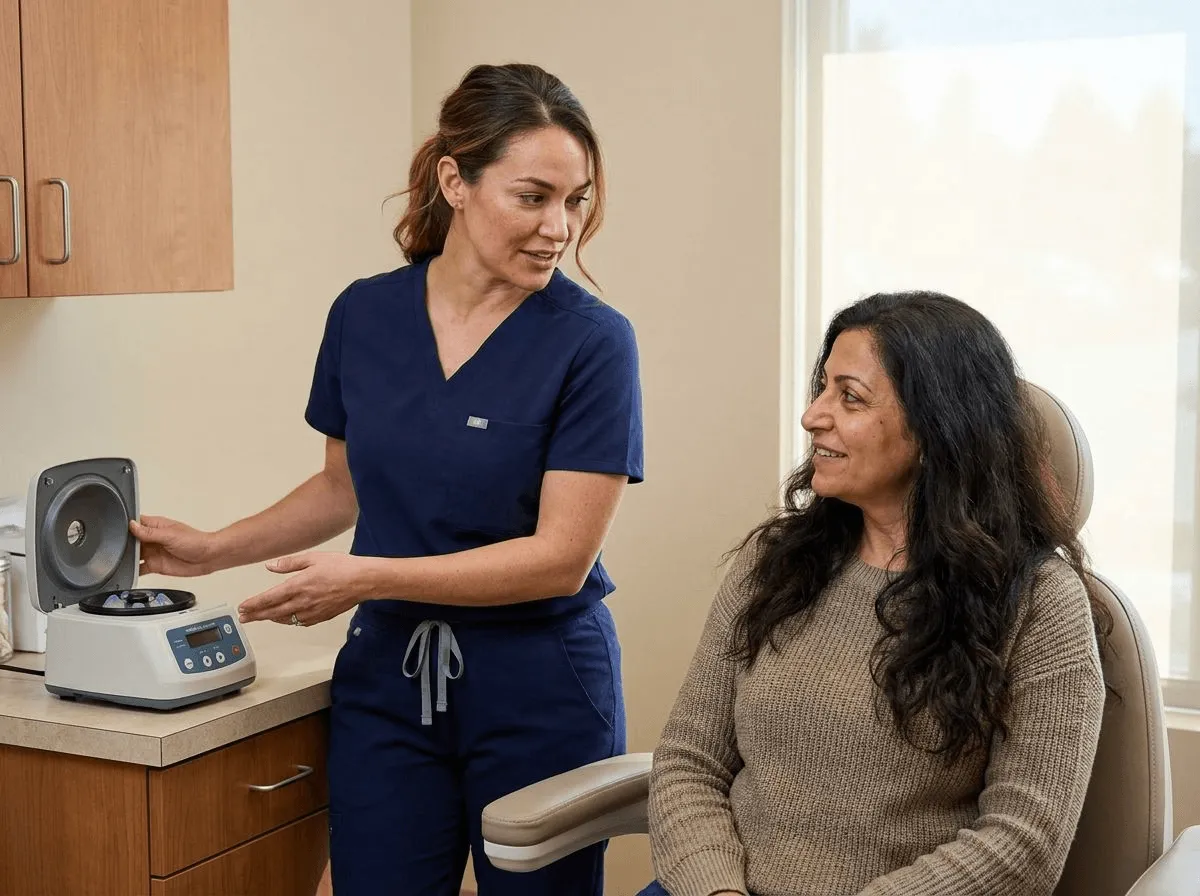
The Protocol Behind the Timeline
The pacing of PRF results is tied directly to the treatment protocol, so it helps to know what that protocol is before tracking progress against it.
At Allen Medical Aesthetics, an initial course is typically three to four sessions, spaced four to six weeks apart. That spacing is deliberate: it gives the scalp time to respond to one round of growth factor delivery before the next session reinforces it. After the initial series, maintenance sessions every six to twelve months are generally recommended to help sustain the benefit.
Because the protocol unfolds over several months, a fair before-and-after comparison cannot really begin until you are well into, or finished with, that initial series. Comparing your scalp after a single session to a friend's scalp after their full course is comparing two different points on the same timeline, not two different outcomes.
Questions about hair restoration?
Our providers offer consultations to discuss your options. The $50 fee is applied toward your first treatment.
Talk to a ProviderHow to Document Your Own Progress
If you want an honest picture of how you are responding to PRF, the tool that matters most is not a mirror, it is a consistent photo routine. Memory is a poor way to judge gradual change. A few simple rules separate a useful photo record from one that is too inconsistent to draw conclusions from.
- Same lighting, every time: natural daylight near a window at the same time of day, or the same indoor light source. Changing light changes how density and scalp visibility appear, independent of any real change in your hair.
- Same part, angle, and point in your routine: photograph the same angles (crown, frontal hairline, part-line) every session, at the same point in your routine, such as freshly washed and air-dried.
- Fixed intervals, not whenever you remember: a baseline photo before your first session, then a set cadence such as monthly, with checkpoints at three, six, and twelve months. Fixed intervals compare like to like instead of an impulsive glance on a good or bad hair day.
- Save the unedited originals: filters and auto-enhancing phone software can distort exactly the details, shaft thickness, part width, scalp visibility, that you are trying to track.
Set a recurring reminder for your photo dates rather than relying on memory. A missed month in the sequence is the single most common reason patients feel like they have no real evidence of change one way or the other.
What Actually Determines Your Individual Outcome
Two patients can follow the identical protocol and see different results, and that difference traces back to a small set of variables rather than random luck.
- Stage of loss at the start: earlier thinning with follicles that are miniaturized but still producing hair gives PRF more to work with than long-standing, complete baldness.
- Whether follicles are still active: PRF supports follicles that are alive, even if slowed down. It cannot restart one that has scarred over or stopped functioning. This single distinction explains more of the variation in outcomes than anything else.
- Age: tissue and follicle health tends to shift with age, which can influence how readily a follicle responds to growth factor delivery.
- Consistency with the session series: the three to four session protocol is not a suggestion. Skipping sessions or stretching the spacing out changes what you are actually evaluating.
- Follow-through on maintenance: PRF supports follicles rather than permanently altering them, so skipping maintenance after the initial series can allow gains to fade.
Who Tends to See More Change, and Who Tends to See Less
Setting expectations before you start beats comparing yourself to a stranger's photos afterward. Patients with early to moderate androgenetic alopecia, a widening part, a receding hairline, or diffuse thinning tied to stress, hormonal shifts, aging, or telogen effluvium tend to have more active follicles for PRF to support, giving them a better foundation for change.
Patients with areas of complete, long-standing baldness are not likely to see meaningful change in those areas from PRF alone. Certain blood disorders, active scalp infections, and blood thinner use that cannot be safely paused can also limit candidacy, which is why a scalp evaluation and medical history review happen at the consultation, before any series begins. None of this is a guarantee in either direction. It is the pattern that determines whether the timeline above is likely to apply to you.
Frequently Asked Questions
Will I see before and after photos of other patients before I start?
We do not publish a gallery of outcome photos, and we would be cautious of any single before-and-after pair, since one other patient's result does not predict yours. What we can walk through at your consultation is the honest timeline and the variables that affect your specific case.
Why does my hair look the same, or worse, after my first PRF session?
PRF works by encouraging resting follicles back toward active growth. In the first few weeks, that can mean older resting hairs shed to make room for new growth, which can look like a step backward. Watch for less shedding over the following months, not immediate fullness.
When should I take my first progress photo?
Before your first session, so you have a true baseline. Use the same lighting, angle, part, and point in your hair-washing routine every time you photograph afterward, ideally on a fixed monthly schedule, so the images are actually comparable to each other.
How long until I can fairly judge whether PRF worked for me?
Most patients notice decreased shedding within one to three months, with density and shaft thickness changes, if they occur, becoming noticeable between three and six months. The fuller picture is generally clear at six to twelve months. Judging the treatment before completing the session series is judging it before it has had a chance to work.
Can PRF regrow hair in an area that is completely bald?
No. PRF supports follicles that are still active, even if miniaturized or resting. It cannot restart a follicle that has scarred over or stopped functioning. Areas of complete, long-standing baldness are generally not good candidates for PRF alone.
Is this the same PRF used for under-eye or lip treatments?
No. PRF hair restoration and PRF EZ Gel both start from a blood draw and centrifugation, but they are prepared and used differently. PRF EZ Gel is combined with a heated albumin gel as a facial biofiller for volume under the eyes, in the cheeks, or along the jawline. PRF for hair restoration is injected directly into the scalp to support existing follicles. Related processes, different goals.
This article supports our Prf Hair Restoration service page. Learn more about treatment options, candidacy, and what to expect.