

Once you have decided PRF hair restoration is worth investigating, the next question is almost always cost. It is a fair question, and it deserves a straight answer. But PRF is not sold the way a single office visit is sold. It is a protocol built around a series of sessions and ongoing maintenance, and the honest answer is that we cannot give you an accurate number without seeing your scalp first.
What we can do is walk you through exactly what shapes that number: how many sessions your case is likely to need, why maintenance is part of the cost rather than an afterthought, and how combining PRF with other treatments changes the total investment. If you have not yet worked through whether PRF is the right treatment for your pattern of thinning, our companion piece on whether PRF actually works is a good place to start before you think about budget.
This guide covers the structural cost drivers behind PRF hair restoration at Allen Medical Aesthetics, how financing works, and why the only reliable way to get a real number is a consultation.
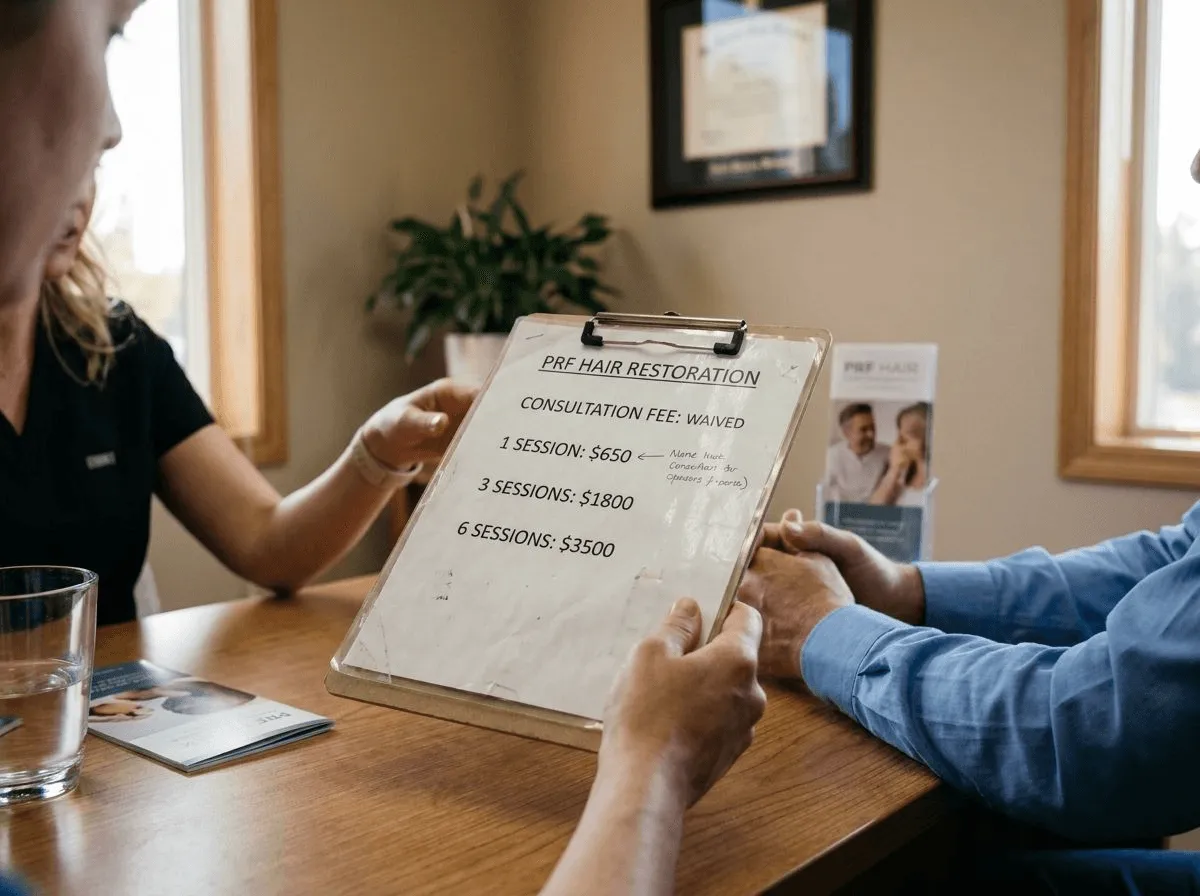
PRF hair restoration is not priced as a single flat fee because it is not a single treatment. The total investment depends on how many sessions your initial series requires (typically three to four, spaced four to six weeks apart), how often you need maintenance afterward (typically every six to twelve months), and whether PRF is combined with other treatments in your plan. We do not publish a price list because those variables are different for every patient. The only way to get an exact number is a consultation, where your provider evaluates your scalp and pattern of thinning and builds a specific plan and price around it.
Think of the cost as a function of your protocol, not a per-injection price. Sessions, spacing, and maintenance cadence are what actually move the number, and financing through Cherry, CareCredit, or Sunbit is available to spread it out.
Why PRF Hair Restoration Does Not Have a Flat Sticker Price
A lot of aesthetic treatments are priced per unit or per session because each visit is independent of the others. PRF hair restoration does not work that way. It is a course of treatment built around a protocol, and the total cost is the sum of that protocol, not a single line item you can look up online.
That is a deliberate choice on our part, not an evasion. A published range for a treatment that varies this much by patient would either be too low to be honest for someone with more extensive thinning, or too high for someone who needs a shorter series. We would rather explain the variables that actually determine your number than post a range that does not describe your case.
- Number of sessions in your initial series, typically three to four
- How much scalp area needs treatment
- How often you need maintenance sessions after the initial series
- Whether PRF is combined with other treatments in the same plan
If a provider quotes you a single flat number for PRF hair restoration before evaluating your scalp and pattern of thinning, ask what that number assumes. A responsible quote follows an assessment, not the other way around.
The Protocol Behind the Price: Sessions and Spacing
At Allen Medical Aesthetics, an initial PRF hair restoration series is typically three to four sessions, spaced four to six weeks apart. Each session takes about 45 to 60 minutes from blood draw to injection. That spacing is part of the protocol, not a scheduling convenience. It gives the scalp time to respond to one round of growth factor delivery before the next session builds on it.
Because the total investment is the number of sessions multiplied by the per-session fee, the biggest single factor in your total cost is how many sessions your case actually needs. A patient with earlier, more limited thinning may complete a shorter series than a patient with more extensive areas to treat. Neither number is fixed until your provider has evaluated your scalp and discussed your goals.
This is also why we do not quote a total series price sight unseen. Two patients asking about the identical treatment can walk out of a consultation with two different session counts, and therefore two different totals.
Maintenance Is Part of the Cost, Not an Upsell
After the initial series, we generally recommend maintenance sessions every six to twelve months to help preserve whatever benefit the initial course produced. That is a recurring cost, and it belongs in your budgeting from the start rather than showing up as a surprise a year later.
How often you need maintenance, and for how long, depends on your individual response and your goals. Some patients space maintenance closer to the twelve month mark. Others prefer more frequent sessions. Your provider will talk through a realistic maintenance cadence at your consultation so the ongoing cost is part of the decision, not something you discover after the initial series is already paid for.
When you evaluate whether PRF fits your budget, price the initial series and a reasonable maintenance cadence together. The initial series alone understates what the full commitment actually costs over time.
Questions about hair restoration?
Our providers offer consultations to discuss your options. The $50 fee is applied toward your first treatment.
Talk to a ProviderCombining PRF With Other Treatments Changes the Total Investment
PRF hair restoration is sometimes combined with other treatments in the same overall plan, such as microneedling, as part of a broader approach to scalp and hair health. Combining treatments adds to the total cost of your plan because you are paying for more than one modality, but it can also mean fewer standalone visits than running each treatment on a completely separate schedule.
Whether combining treatments is worth it for you depends on your goals and your budget, not a general rule that applies to every patient. This is a decision to make with your provider during your consultation, where you can ask directly whether adding a second treatment to your plan changes your per-visit cost or your total investment for the year.
How PRF Compares to Ongoing Alternatives, as a Cost Structure
It is worth understanding how PRF is shaped financially compared to other approaches to hair thinning, without making any claim about which one works better for you. That is a candidacy question for your consultation, not a marketing comparison.
PRF is a bounded course: an initial series of three to four sessions, followed by maintenance every six to twelve months. Many topical and over-the-counter approaches to hair thinning, by contrast, are an ongoing monthly purchase with no defined endpoint. That is a difference in how the cost is structured over time, a finite series plus periodic maintenance versus an indefinite recurring purchase, not a statement about outcomes. Which structure makes more sense for your budget and your goals is exactly what a consultation is for.
Financing PRF Hair Restoration and Getting an Exact Number
PRF hair restoration is an elective treatment and is not covered by health insurance. To make the investment more manageable, Allen Medical Aesthetics offers financing through Cherry, CareCredit, and Sunbit, which allow qualified patients to spread the cost of a series across monthly payments rather than paying the full amount upfront.
Every variable in this guide, session count, area, maintenance cadence, and whether you combine treatments, comes together differently for each patient. The only way to see how they add up for you is a consultation with our clinical team, where we evaluate your scalp and pattern of thinning and build a specific plan and price around it.
If you are ready for that conversation, call (206) 414-9979 or schedule a PRF hair restoration consultation to get a plan and price built around your scalp, not a generic range. For a realistic sense of what results look like over time before you commit to a series, our PRF hair before and after guide is a useful next read.
Frequently Asked Questions
How much does PRF hair restoration cost?
We do not publish a flat price because PRF hair restoration is priced as a protocol, not a single treatment. The total depends on how many sessions your initial series requires (typically three to four), how much scalp area needs treatment, and how often you need maintenance afterward. A consultation is the only way to get an exact number for your case.
Why is PRF priced as a series instead of a single session?
PRF works by supporting hair follicles over a hair growth cycle that unfolds across months, not in one visit. An initial series of three to four sessions, spaced four to six weeks apart, is the protocol, so the total cost reflects that full series rather than a single injection.
Do I have to keep paying for maintenance sessions indefinitely?
Maintenance sessions every six to twelve months are generally recommended to help preserve the results of the initial series. How long you continue maintenance is a decision you make with your provider based on your individual response and goals, and it should be budgeted as part of the ongoing cost from the start.
Does combining PRF with other treatments cost more?
Combining PRF with another treatment, such as microneedling, adds to your total plan cost because you are paying for more than one treatment. It can also reduce the number of separate visits compared to running each treatment on its own schedule. Ask your provider during your consultation whether combining treatments changes your overall cost.
Is PRF hair restoration covered by insurance?
No. PRF hair restoration is an elective cosmetic and regenerative treatment and is not covered by health insurance. Most patients pay out of pocket or use financing to spread the cost over time.
What financing options does Allen Medical Aesthetics offer?
We offer financing through Cherry, CareCredit, and Sunbit, which allow qualified patients to spread the cost of a PRF series across monthly payments instead of paying the full amount upfront. Ask about financing when you schedule your consultation.
Related Articles
This article supports our Prf Hair Restoration service page. Learn more about treatment options, candidacy, and what to expect.